
Vinuni_CVMAIL Wins 1st Place Overall at the MICCAI 2026 MedReason Challenge
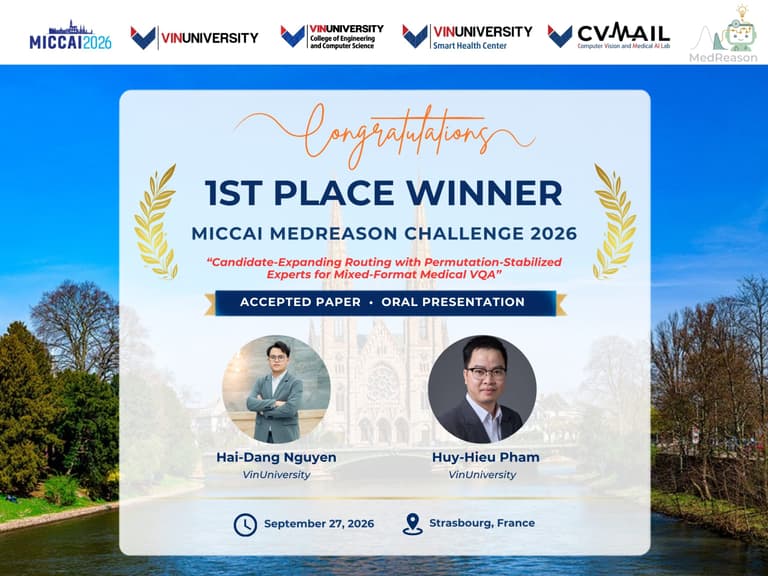
We are delighted to share that the Vinuni_CVMAIL team has achieved 1st Place Overall in the MedReason Challenge 2026 at MICCAI 2026. Our accompanying paper, “Candidate-Expanding Routing with Permutation-Stabilized Experts for Mixed-Format Medical VQA,” has been accepted to the MedReason Individual Method Paper Track at MICCAI 2026. The track organizers state that accepted papers are scheduled for inclusion in the forthcoming Springer Lecture Notes in Computer Science proceedings.
The team was represented by Hai-Dang Nguyen and Huy-Hieu Pham from VinUniversity. MedReason evaluates whether medical multimodal systems can remain accurate, visually grounded, and reliable under domain shift across both multiple-choice and open-ended medical visual question answering.
Final challenge result
Among the 15 teams included in the final evaluation, Vinuni_CVMAIL obtained the lowest average rank of 2.667, resulting in the top overall position.
| Metric | Score | Rank |
|---|---|---|
| Overall | Average rank: 2.667 | #1 |
| Open-ended GT | 2.410 / 4 | #1 |
| Open-ended VA | 3.155 / 4 | #2 |
| MCQ Accuracy | 62.00% | #5 |
The final evaluation covered 400 cases—200 multiple-choice and 200 open-ended—combining pre-evaluation and hidden test data. The official overall ranking averages each team’s rank across the three reported metrics, rewarding balanced performance across question formats.
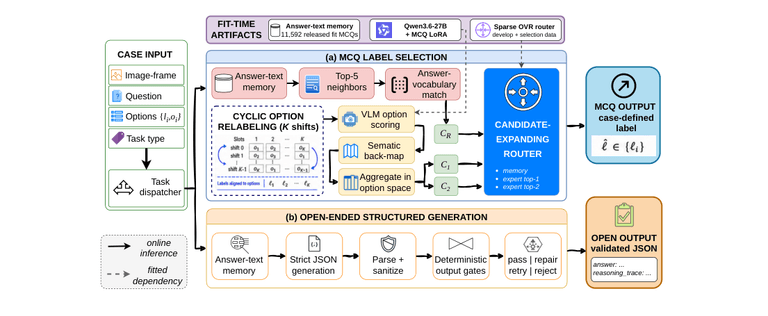
Candidate expansion for mixed-format medical VQA
Our system separates multiple-choice and open-ended questions into task-specific inference paths. For multiple-choice questions, an answer-text memory and a permutation-stabilized vision-language expert independently generate candidates. The expert’s top-1 and top-2 predictions are retained and combined with the memory candidate through a sparse candidate-expanding router.
For open-ended questions, the system uses structured generation, parsing, sanitization, and deterministic output gates to maintain a reliable machine-readable output contract. These two paths target different failure modes: option-order sensitivity in multiple-choice selection and malformed serialization in free-text outputs.
In retrospective internal MCQ analysis, adding the expert top-2 candidate improved matched routing accuracy from 88.95% to 91.73% and increased oracle coverage from 90.31% to 96.15%. The final retrospective configuration reached 92.23%. All 475 participant-facing open-ended outputs were schema-valid without repair, retry, or hard-gate failure. These findings are retrospective development evidence and should not be interpreted as independent hidden evaluation or clinical validation.
Accepted paper and MICCAI 2026 presentation
The paper is authored by Hai-Dang Nguyen and Huy-Hieu Pham. The team has been invited to give an oral presentation at the MedReason Challenge & Workshop on September 27, 2026, in Strasbourg, France. Vinuni_CVMAIL will also receive a MedReason 2026 Challenge Award in recognition of the final ranking.
This achievement reflects our continued work on reliable medical AI, multimodal reasoning, robust model selection, and clinically grounded visual understanding.