MedGemma reaches Nature Medicine: strong benchmarks, not a clinical green light
A peer-reviewed Nature Medicine paper published on 6 October 2026 evaluates MedGemma, Google’s family of medical AI models built on Gemma 3. The research reports gains across text and imaging benchmarks, positioning the models as starting points for healthcare application development. Read the paper.
This is a new journal publication, not a newly launched model family. The earlier MedGemma Technical Report was first submitted to arXiv on 7 July 2025; its latest listed revision is dated 6 April 2026. See the preprint history.
What the study shows
The authors evaluated medical question answering, image classification, report generation and agentic tasks. They report advantages over the base Gemma models on several evaluations, including tasks whose datasets were not used for medical training or tuning. Fine-tuning MedGemma also performed better than fine-tuning Gemma 3 in some medical settings, particularly with limited training data. Study methods and results.
The authors disclose that all but two are current or former Google employees and may own company stock. Competing interests.
What the evidence establishes—and what it does not
| Topic | Verified finding | Interpretation limit |
|---|---|---|
| Publication | Peer-reviewed Nature Medicine article, 6 October 2026 | Journal publication, not a new model launch |
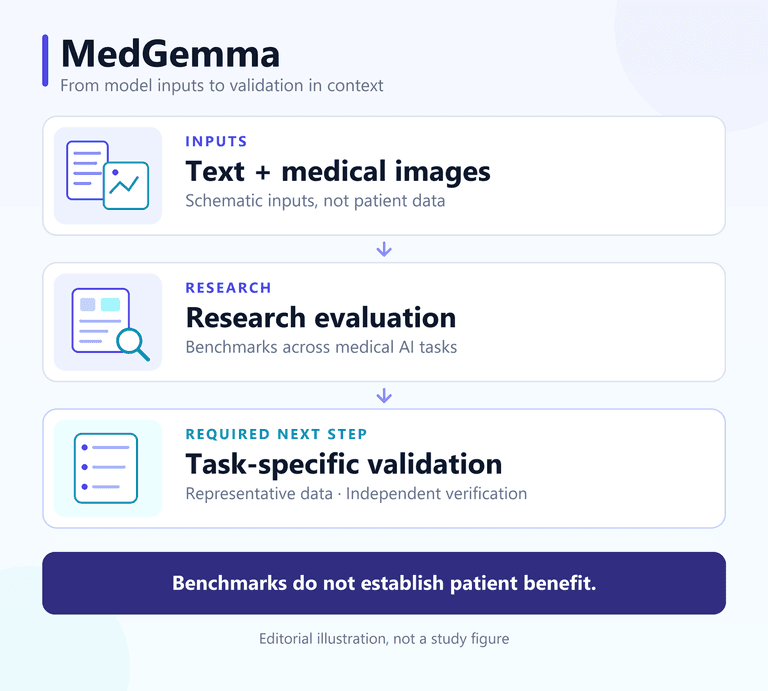
| Evaluation | Medical text and imaging benchmarks | Not proof of improved patient outcomes |
| Availability | Open weights under applicable terms | Not equivalent to fully open-source |
| Clinical use | Model card warns against using outputs for direct clinical decisions | Task-specific validation and independent verification remain necessary |
Open weights, with responsibilities attached
Google describes its Health AI Developer Foundations models as open-weight, rather than fully open-source: developers can download and adapt the weights under the applicable terms, but not all training-related code is public. The models can run on local or cloud infrastructure. Developers remain responsible for evaluating them on their own data and intended tasks. Google’s developer FAQ.
What the results do not establish
The MedGemma 1 model card is explicit about the boundary: its outputs are not intended to guide diagnosis, treatment or other direct clinical decisions. Errors remain possible even in familiar medical domains, and outputs require independent verification. Intended-use limitations.
The same documentation calls for validation on data representative of the intended setting, including relevant patient characteristics and imaging equipment. It also warns that exposure to related information during pretraining can inflate apparent generalization. Validation considerations.
Our reading: this is progress in medical-AI development, not a ready-made AI clinician. Patient benefit requires evidence beyond a strong benchmark score.