
MASAI Trial Tests AI Mammography Beyond Detection Rates
Research brief · Peer-reviewed Lancet report, January 2026
The Swedish MASAI trial adds randomized evidence about AI-supported mammography. Its 2026 analysis found a non-inferior interval-cancer rate, higher sensitivity and unchanged specificity compared with standard double reading. The paper’s institutional record provides the primary results and identifies the work as peer reviewed.
The result beyond screening-day detection
Interval cancers are diagnosed after a screening examination, before the next screening round. The trial randomized 105,934 women; 19 were excluded from this analysis.
MASAI results reported in the 2026 analysis
| Measure | AI-supported screening | Standard double reading |
|---|---|---|
| Interval cancers per 1,000 participants | 1.55 | 1.76 |
| Sensitivity | 80.5% | 73.8% |
| Specificity | 98.5% | 98.5% |
The interval-cancer ratio was 0.88 (95% confidence interval 0.65–1.18; P=0.41), meeting the prespecified non-inferiority criterion. It did not demonstrate a statistically significant reduction. Sensitivity differed at P=0.031. Source: primary paper abstract.
What AI actually did
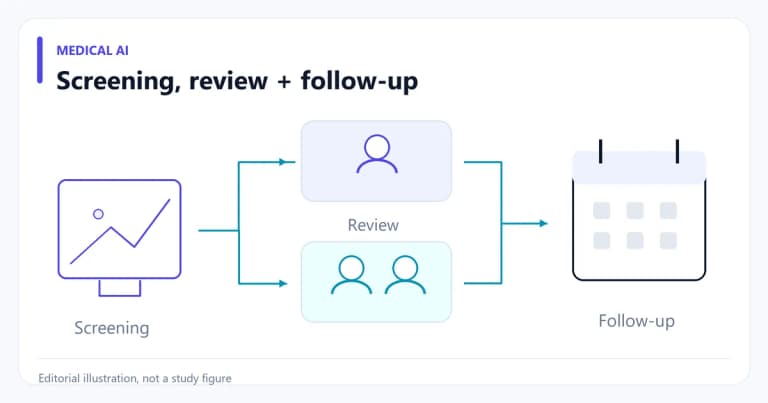
According to Lund University’s account, AI helped route mammograms to one or two radiologists and highlighted suspicious findings during interpretation. The imaging examination itself was unchanged. This was a human–AI screening workflow, rather than a system independently managing participants.
The university also reported a roughly 44% reduction in screen-reading workload across the trial’s strategy. Workload is an operational measure, not a direct measure of survival or the overall cost of a screening program. Readers should keep those categories separate.
An earlier, 2025 MASAI paper reported screen-detection rates of 6.4 versus 5.0 cancers per 1,000 participants. That finding and the later interval-cancer analysis describe different stages of screening evaluation. Combining their figures without naming the endpoint can make coverage confusing.
What this means for AI coverage
Editorial interpretation: the most useful headline is about a tested screening strategy, not a claim that AI has solved breast cancer detection. Non-inferiority asks whether performance stays within a predefined acceptable boundary. Superiority asks a different question. Reporting one as the other would change the meaning of the trial.
For future reporting, important questions include replication in other screening programs, costs, consequences of additional investigations and longer-term outcomes. These are questions to examine, not benefits established here. Keeping the endpoint, comparator and uncertainty visible makes this research more useful to readers than an unsupported promise of universal improvement. This brief does not offer individual screening advice.