
Google Deep Review Opens AI Document Review to More Researchers
Google Research announced the public release of Deep Review on October 14, 2026. The system analyzes technical documents and produces structured feedback. At launch, Google lists PDF and plain-text inputs; multi-file support is planned rather than already available. The announcement describes two complimentary reviews per week and an API route for higher-volume workflows. These are launch terms, not a guarantee of permanent availability. Google Research announcement.
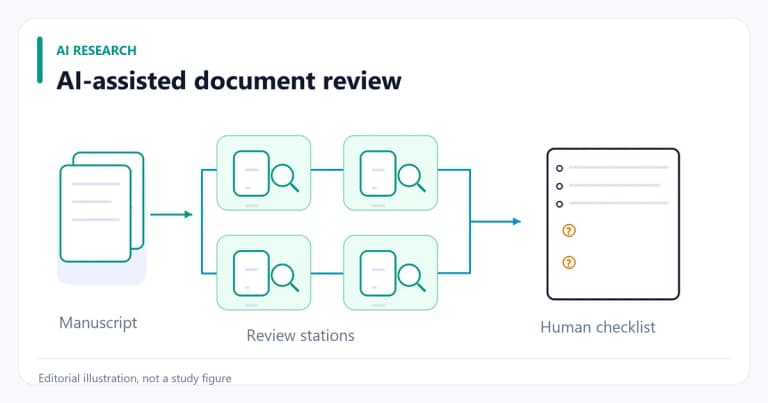
How the review is organized
The system divides work among agents rather than relying on one response to a complete manuscript. Google describes the following sequence.
Deep Review workflow, summarized from Google’s October announcement
| Stage | Purpose |
|---|---|
| Segmentation | Split the document into logical sections. |
| Budget allocation | Assign more computation to demanding material. |
| Parallel checking | Review sections with access to document context. |
| Synthesis | Combine findings and check supporting evidence. |
What the earlier research actually establishes
Deep Review developed from the Paper Assistant Tool. The team’s June 26 preprint describes pre-submission pilots at STOC and ICML, not automated conference acceptance decisions. It also reports important failure modes: parsing problems, outdated information, and incorrectly challenging valid arguments. These observations concern the earlier system and should not be presented as a measured error rate for the October release. Paper Assistant Tool preprint.
Editorial analysis: turn criticism into a testable checklist
For a research group, a useful trial would begin with a finished, non-confidential manuscript whose weaknesses are already understood. Ask whether the report identifies those weaknesses, whether it invents new ones, and how long a researcher needs to adjudicate the output. Count useful corrections and time spent checking false alarms separately.
A strong-looking review is not enough. Each important criticism should point to a passage, equation, experiment, or reference that a person can inspect. When the system proposes another experiment, record the scientific question it would answer before allocating compute. When it challenges a proof, reproduce the disputed step independently instead of rewriting the argument merely to satisfy the tool.
Our suggested workflow is to classify findings as confirmed, unresolved, or rejected, then keep that record alongside manuscript revisions. This makes the tool easier to evaluate over repeated projects. Researchers should also check their institution’s confidentiality rules and the service’s current data terms before uploading unpublished work. The immediate opportunity is an additional review pass with an auditable trail, while authors retain responsibility for the final claims.