
Gemini 4 Argon Robotics Demos Put Simulation in the Loop
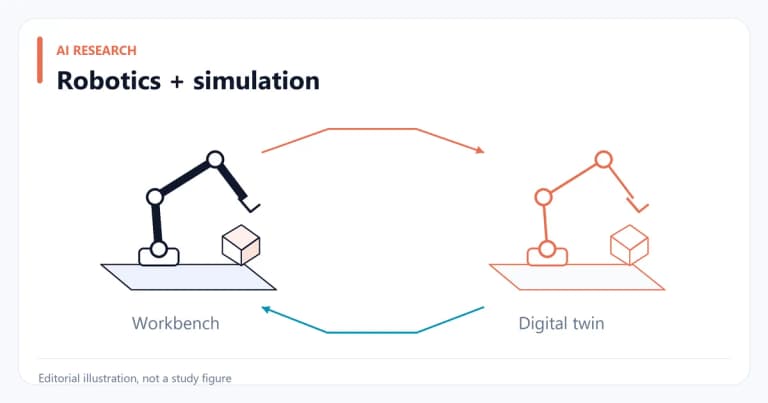
Google’s October 13, 2026 developer post presents Gemini 4 Argon across robotics workflows, from camera-based reasoning to simulation and physical control. The examples are demonstrations published by the developer, not an independent assessment of deployment reliability. Their most useful research theme is the connection between observing a scene, building a simulation, and checking a proposed action. Google Developers announcement.
What Google demonstrates
Selected demonstrations described in the October 13 post
| Workflow | Published example |
|---|---|
| Control with practice | A quadruped rehearses using a pedal-operated bin in MuJoCo. |
| Real-to-simulation | Robot recordings inform a digital scene with calibrated contact behavior. |
| Training-data generation | A tabletop image starts a simulated data-collection workflow. |
These examples depend on surrounding tools, cameras, action interfaces, and task definitions. The post provides representative prompts that expose parts of those arrangements. Source for the demonstrations.
A reasoning benchmark is a different measurement
The announcement also references ERQA. Its official repository describes a multiple-choice benchmark with interleaved images and text, focused on spatial reasoning and world knowledge. The repository includes 400 examples and an evaluation harness. That format measures answers to questions, rather than repeated physical execution of robot tasks. Researchers should keep those categories separate when comparing claims. ERQA dataset and evaluation repository.
Editorial analysis: ask for the missing denominator
A demonstration can reveal an interesting workflow without establishing how often it succeeds. For a reproduction, the first question should be how many trials were attempted, not simply whether the published video ends well. Record initial conditions, retries, human interventions, and failures alongside successful runs. A system that recovers after several attempts may still be useful, but recovery must be counted rather than edited away.
Separate tests of perception, planning, simulation accuracy, and execution. If an object is misplaced, determine whether the error came from its estimated pose, the simulated physics, or the physical controller. This separation makes negative results more informative and helps identify where another model or conventional algorithm might be sufficient.
For an initial study, we would favor a bounded simulator task with fixed evaluation rules over immediate hardware autonomy. Hardware testing should follow the laboratory’s existing supervision and safety procedures. Preserve the prompts, tool versions, observations, and intervention log so another team can understand what was actually reproduced.
The research opportunity is a more inspectable loop between reasoning and action. The published examples provide starting points for that work, while robust performance across unfamiliar settings remains something a team must test directly.