
EmbeddingGemma 2 Brings Multimodal Search to Local Devices
Google announced EmbeddingGemma 2 on October 6, 2026, extending its embedding-model family beyond text. The release maps text, code, images, audio, and video into a shared representation for search and related tasks. Google positions the model for on-device applications and distributes it under Apache 2.0. This is an embedding release: its output represents information for retrieval, rather than serving as a conversational answer by itself. Official launch announcement.
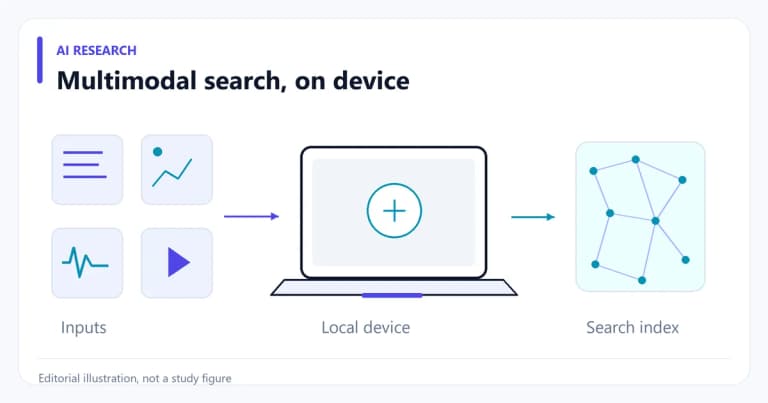
A model that can load only the needed modalities
The technical card documents a modular design. Teams can compare the configurations below before deciding which inputs their application really needs.
EmbeddingGemma 2 configurations documented by Google
| Inputs enabled | Parameters loaded |
|---|---|
| Text only | 270 million |
| Text and images | 440 million |
| Text and audio | 570 million |
| Full multimodal | 740 million |
The card specifies 768-dimensional output, with supported truncation to 512, 256, or 128 dimensions. It warns that the smallest option substantially reduces multimodal quality and recommends renormalizing shortened vectors. It also specifies bfloat16 or float32, not float16, for inference. Model card and implementation guidance.
Editorial analysis: evaluate retrieval before adding generation
A practical research use case to investigate is a local collection containing paper text, slide images, recorded talks, and code. Instead of immediately building a full assistant, start by asking whether the correct item appears near the top of the search results. That smaller question is easier to inspect and gives a cleaner signal about the embedding model.
Build a modest test set from questions the intended users actually ask. Include ambiguous wording, near-duplicate documents, and cases where the right answer is absent from the collection. Label relevant results before comparing configurations, then keep the same queries and ranking metric across runs. This prevents a smaller vector from looking successful merely because its examples were easier.
Measure end-to-end indexing time, query latency, and peak memory on the intended device. Parameter count alone does not describe the complete application footprint. Include media decoding, the vector index, and any answering model in the measurement. Treat offline operation as a property to verify across the whole pipeline, including telemetry and synchronization settings, rather than assuming that one local component guarantees privacy.
The release offers a concrete candidate for multimodal retrieval experiments. The sensible next step is a small, reproducible comparison against the team’s existing search baseline, not an automatic migration based on a vendor ranking.