
Diffusion Controller Research Explains a New Way to Steer Images
Google Research highlighted Diffusion Controller on September 29, 2026, describing a lightweight network for steering image generation. The underlying preprint was submitted on March 7. This is a research explainer prompted by the September write-up, not a claim that the paper first appeared this month. Google Research overview; dated preprint record.
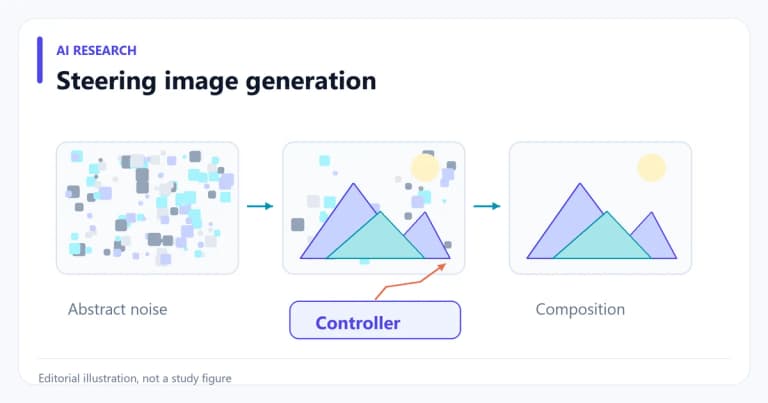
The idea: control the path of generation
The paper treats reverse diffusion as a control problem. A learned correction steers the generation process while a regularization cost discourages excessive departure from the pretrained model. In its gray-box configuration, the backbone stays frozen and the controller uses exposed intermediate denoising outputs. This requirement matters: the paper does not establish compatibility with every service that returns only a finished image. Diffusion Controller paper.
Access distinctions in the research, with an implementation implication
| Setting | Relevant access |
|---|---|
| Gray-box | Intermediate denoising information is exposed; the backbone remains fixed. |
| White-box | Internal model components can be modified. |
| Finished-image-only API | Compatibility is not established by the described gray-box setup. |
The first two rows summarize the paper’s access definitions; the final row is an implementation inference from those requirements.
Keep the experimental scope visible
Google’s overview describes experiments using Stable Diffusion v1.4 under supervised, reward-weighted, and PPO training regimes. It discusses preference-based evaluation and human judgments. These experiments do not by themselves demonstrate the same behavior on all contemporary image models. The overview also presents personalization, safety mechanisms, and video control as future directions rather than completed deployment results. Experimental summary and outlook.
Editorial analysis: a stronger score needs a clear target
For a team considering a reproduction, define the desired improvement before choosing a reward. Object presence, spatial arrangement, visual appeal, and faithfulness to a reference are different targets. A single aggregate score can conceal a regression in one of them. Keep a small set of clearly specified prompts for each target and include difficult counterexamples.
Compare the controller with the same backbone, prompts, inference budget, and random seeds where practical. Review outputs without revealing which method generated them, and report disagreement among reviewers instead of treating subjective preference as an exact physical measurement. Include runtime and training expense alongside image-quality judgments.
The framework is worth studying as a modular way to organize adaptation. Before planning integration, however, verify that the intended model exposes the required information and that its license permits the proposed use. The useful question is whether the method improves a defined workflow under reproducible conditions, rather than whether it can be described as universal image control.